Table of Contents
Speed Kills… Your Competitors
Most real estate leaders look at “Lagging Indicators.” They look at last month’s closings report and say, “Good job,” or “Do better.”
This is like driving a car while looking only in the rearview mirror. You can see where you’ve been, but you have no idea what’s ahead. You can’t steer. You can’t accelerate. You crash.
To grow, you need to measure the Pulse of your business right now. You need to measure Velocity.
GCI vs. Units: The MREA Distinction
Before we dive into velocity, let’s clarify a fundamental metric confusion:
Units measure volume (busyness).
GCI (Gross Commission Income) measures value (profitability).
You can close 50 rental units at $500 commission each and make $25,000. Or you can close 5 luxury listings at $15,000 commission each and make $75,000.
Same amount of work. 3x the income.
Tracking Units alone is a vanity metric. It makes you feel busy. Tracking GCI is a sanity metric. It tells you if you’re actually building wealth.
MREA teaches this ruthlessly: “It’s not about how many deals you do. It’s about how much money you make per deal.” But even GCI isn’t enough if you want to scale.
The Missing Metric: Time
Here’s what most CRMs don’t tell you:
- Agent A generates $100,000 GCI in 6 months.
- Agent B generates $100,000 GCI in 12 months.
On a traditional spreadsheet, they look identical. Both hit $100K. Both get the same pat on the back.
But Agent A is 2x more valuable to your business. Why?
Because they turn capital faster. They convert leads to commissions in half the time. Their Velocity is double.
If you had to choose which agent to clone, you’d choose Agent A every time. But most leaders don’t have this data because their systems don’t measure time gaps.
How Lync Team Tracks “Velocity”
We introduced a concept called Team Velocity into our analytics engine. This isn’t just about the amount of money; it’s about the speed of the money.
Velocity answers the question: “How fast does this team turn leads into cash?”
The Technical Logic: Time-Gap Analysis
The system analyzes the TeamPerformanceLog to calculate the time elapsed between key pipeline milestones:
Gap 1: Lead Generated → Appointment Set
Industry Average: 3-5 days
Top Performers: <24 hours
This measures how fast your team responds to opportunities. If leads sit in the CRM for 5 days before anyone calls them, your velocity is slow—regardless of how many deals you close.
Gap 2: Appointment Set → Contract Signed
Industry Average: 14-21 days
Top Performers: 7-10 days
This measures your conversion effectiveness. How many showings does it take to get a signature? How strong is your closing script?
Gap 3: Contract Signed → Deal Won (Closed)
Industry Average: 30-45 days
Top Performers: 21-30 days
This measures your transaction management. How fast can you push a deal through underwriting, appraisal, and closing? Are you proactive or reactive?
The Formula:
Velocity Score = (Total GCI) / (Average Time Gap)
Or more precisely:
Velocity Score = (Annual GCI) / (Avg Days from Lead → Close)
Example:
- Agent A: $150K GCI, Avg 90 days Lead → Close = Velocity Score of 1,667
- Agent B: $150K GCI, Avg 180 days Lead → Close = Velocity Score of 833
Agent A’s velocity is 2x higher, even though they made the same money.
Why This Matters for Leaders
Traditional CRMs show you what happened. Lync Team shows you how fast it happened.
This changes how you coach:
Old Way (Lagging):
“You closed 3 deals last month. Good job.”
New Way (Leading):
“Your Lead → Appointment gap is 6 days, which is 3x slower than the team average. Let’s fix your follow-up system.”
Velocity pinpoints exactly where agents are slow, so you can intervene with precision.
The Real-Time KPI Dashboard
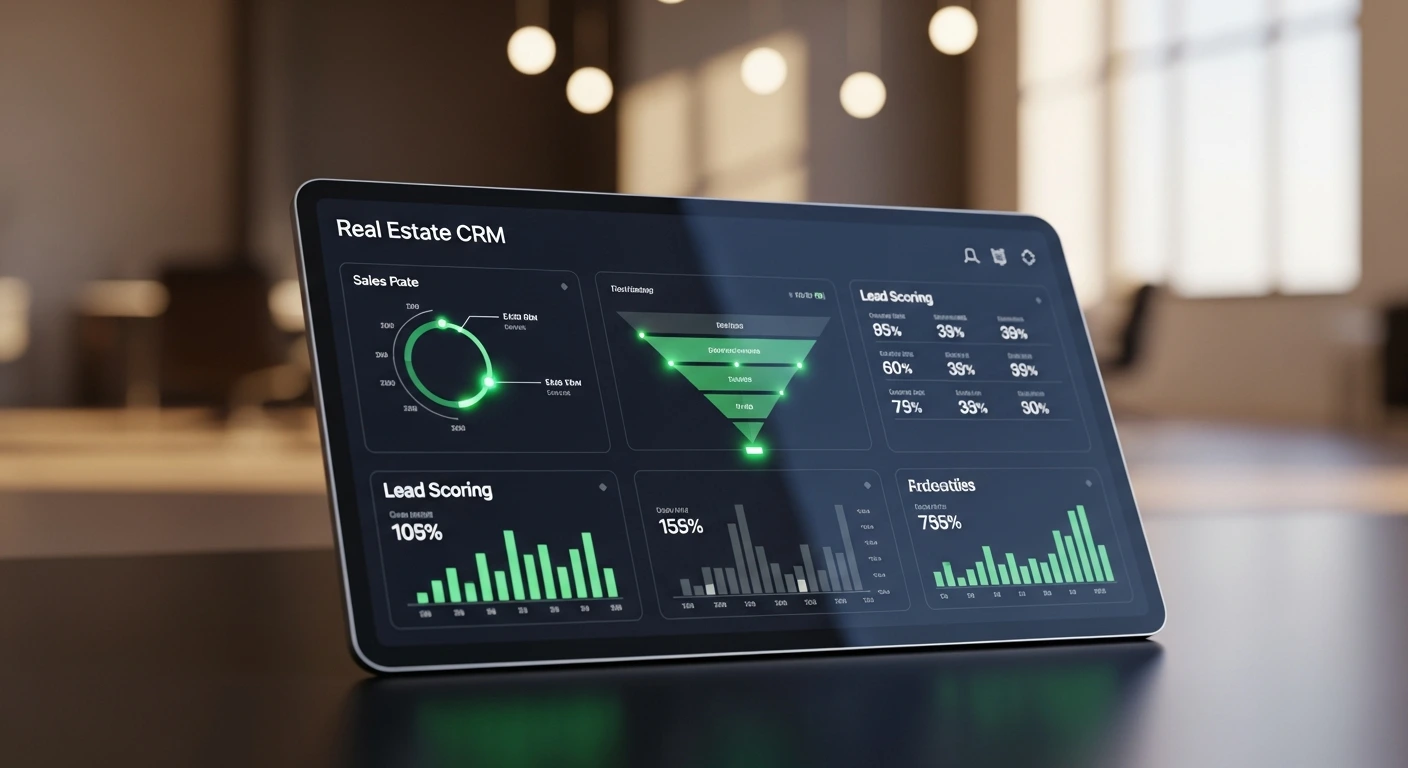
When you log into Lync Team’s Performance Analytics View, you see:
Section 1: GCI Forecast (Real-Time)
- Month-to-Date GCI: $47,320 (deals closed)
- Pipeline GCI: $128,000 (deals under contract)
- Forecasted GCI (Next 30 Days): $89,500
This isn’t historical. It’s predictive. The system calculates GCI based on:
- Deals in “Under Contract” stage × Commission Rate × Probability of Close
- Historical close rates for each agent
If you have $128K in pipeline but your historical close rate is 75%, the system forecasts $96K in actual GCI.
Section 2: Velocity Scores (Agent Leaderboard)
| Agent | GCI YTD | Avg Days Lead→Close | Velocity Score |
|---|---|---|---|
| Agent A | $180K | 82 days | 2,195 |
| Agent B | $150K | 125 days | 1,200 |
| Agent C | $120K | 95 days | 1,263 |
The leaderboard isn’t sorted by GCI—it’s sorted by Velocity. This reveals who’s running the most efficient business, not just who closed the most deals.
Section 3: Bottleneck Identification
The system flags where your team is slow:
- Lead → Appointment: Team Average 4.2 days (🔴 Red - Industry standard is 2 days)
- Appointment → Contract: Team Average 12 days (🟢 Green - Good)
- Contract → Close: Team Average 38 days (🟡 Yellow - Could improve)
The leader sees: “Our team is slow at initial response. We need to implement speed-to-lead protocols.”
Velocity-Based Coaching
Once you have velocity data, you can coach with surgical precision.
Scenario 1: Low Lead → Appointment Conversion
Problem: Agent takes 7 days to call new leads.
Solution: Implement “5-Minute Rule” – all new leads called within 5 minutes.
Expected Impact: Velocity Score increases 30-40%.
Scenario 2: High Appointment → Contract Gap
Problem: Agent does 15 showings per contract.
Solution: Role-play objection handling. Implement buyer consultation script.
Expected Impact: Reduce showings per contract to 8. Velocity increases 50%.
Moving from Lagging to Leading Indicators
Stop waiting for the closing statement to know how your business is doing.
Use Velocity Tracking to identify who is sprinting and who is stalling. Use it to diagnose exactly where your team is slow. Use it to forecast future income based on current pipeline speed.
Action Step: Check your Team Velocity Score today in the Performance Dashboard or the main Organization Dashboard and identify your slowest time gap. Fix that one bottleneck this month and watch your entire operation accelerate.
The fastest teams win. Not because they work harder—because they work faster.